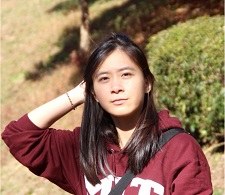
Yanran Wang
略歴
2019年9月01日 University of Alberta (B.S., Mathematical Physics)入学
2017年6月30日 同 上 卒 業
2019年4月01日 京都大学大学院工学研究科電気工学専攻修士課程入学
2021年3月23日 同 上 修 了
2021年4月01日 京都大学大学院工学研究科電気工学専攻博士後期課程進学
2024年3月25日 同課程所定の研究指導認定見込
2024年4月15日 University of California, Santa Barbara (Department of Mechanical Engineering & Institute for Collaborative Biotechnologies), Postdoctoral researcher
メッセージ
My motivation for pursuing a doctoral degree was actually very simple: I truly love research. I enjoy the process of thinking deeply about a problem, learning new ideas, and trying to discover something that was not understood before. During my studies, I found that research gave me a sense of curiosity, freedom, and purpose that I could not find elsewhere. Rather than choosing a doctoral course because of external pressure or because I had a fixed career plan, I chose it because I wanted to continue exploring challenging questions and growing as an independent thinker. Looking back, that was the right decision for me.
My doctoral training in Electrical Engineering at Kyoto University has been extremely valuable in building my career, even though my current field is in biology and biophysics. At first glance, these areas may seem quite different, but the core skills I developed during my Ph.D. remain central to what I do today. My training taught me how to think quantitatively, how to build and analyze models, how to break down complicated systems into understandable parts, and how to connect theory with real-world observations. These skills are highly transferable and have allowed me to move across disciplines with confidence. In my current research, I use ideas from physics, mathematics, and engineering to study biological systems. In that sense, my doctoral degree did not limit me to one narrow path; instead, it gave me a strong foundation that continues to support new directions in my career.
As for worries about going on to a doctoral course, I can honestly say that I did not have many. Because I genuinely enjoyed research, pursuing a Ph.D. felt like a natural step rather than a burden. Of course, a doctoral program is challenging. There are moments of uncertainty, failed experiments, and long periods when progress feels slow. But I think this is a normal part of research, not something to fear too much. If you are someone who enjoys asking questions, thinking independently, and learning from difficulties, then those challenges become meaningful rather than discouraging. For me, the excitement of discovery always outweighed the uncertainty.
To junior students who are considering a doctoral degree, my message is this: do not be afraid to follow your curiosity. You do not need to have every detail of your future planned out before starting. What matters most is whether you are excited by the process of research itself. A Ph.D. is not only about gaining specialized knowledge; it is also about learning how to think, how to solve problems, and how to persist through uncertainty. These abilities will remain valuable no matter what field you eventually work in. Research can also open unexpected doors. In my own case, training in electrical engineering eventually led me into biophysics and molecular biology, and that interdisciplinary journey has been one of the most rewarding parts of my career.
I am very grateful for the education and training I received at Kyoto University. It gave me not only technical knowledge, but also the confidence to pursue difficult questions and to build a career driven by curiosity. I hope more students who are excited by discovery will consider the doctoral path and find their own way to contribute to science.
(2026年7月掲載)