
Self Introduction
准教授 PILLAI, ABHISHEK-LAKSHMAN
After graduating with my doctoral degree in March 2018, my professional career as an independent researcher officially took root. I was appointed as a Program-Specific Researcher in the Thermal Science and Engineering Laboratory under the mentorship of Prof. Ryoichi Kurose in the Department of Mechanical Engineering and Science. I was later promoted to Assistant Professor in November 2019, and I am proud to currently serve as an Associate Professor within the same department.
My research lies in the broad area of turbulent combustion, with a specialized focus on uncovering the mechanisms and predicting the complex flow and transport phenomena encountered in the turbulent combustion of carbon-free fuels (e.g., hydrogen, ammonia). Specifically, I investigate thermo-acoustic instabilities, flame-wall interactions, flashback, spray combustion behaviour and its modelling, and combustion noise in wall-bounded turbulent reacting flows. To tackle these intricate gas-phase and multiphase combustion problems, my work utilizes sophisticated, large-scale numerical simulation techniques, such as Direct Numerical Simulation (DNS), Large-Eddy Simulation (LES), and Computational Aero-Acoustics (CAA), executed on world-class supercomputers like the Fugaku.
Driven by the urgent need for global decarbonization, my ultimate aspiration is to establish a world-leading research group dedicated to the transition toward carbon-free energy systems. Taking steps toward this vision, I recently secured an opportunity to collaborate with Prof. Matthias Ihme at the FxLab at Stanford University through the JSPS International Collaborative Research Grant. This project focuses on clarifying noise generation mechanisms and predicting noise emissions from the confined combustion of hydrogen and hydrogen-ammonia blends. As part of this initiative, I had the honor of serving as a Visiting Assistant Professor at Stanford University’s Department of Mechanical Engineering in 2024. The photo on the bottom-right of the previous page shows me preparing combustion noise experiments at Stanford University.
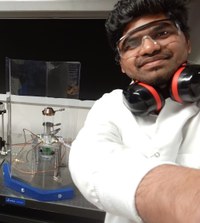
Having lived in the beautiful city of Kyoto for over 12 years now, I have been deeply enriched by the opportunity to collaborate with outstanding researchers and students both locally and internationally. What I find most extraordinary about Kyoto University is how it systematically cultivates a habit of innovation. Watching my colleagues and students tackle complex challenges with such passion and creativity keeps me continuously inspired.
I feel incredibly fortunate to be part of this institution. I am deeply grateful to my fellow researchers, my students, and especially my mentor, Prof. Ryoichi Kurose, who have supported and inspired me at every step of the way. I truly believe that Kyoto University will continue to nurture and grow this rich culture of academic excellence for generations to come. Finally, I leave you with some beautiful images of flames that I generated using the data from my numerical simulations.
|
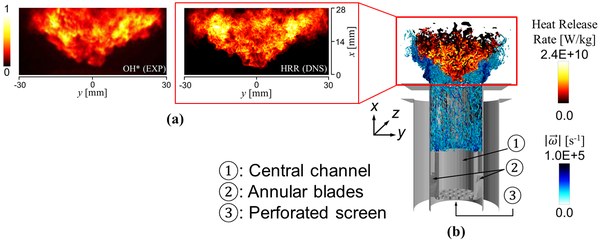
Figure 1: (a) Comparison of normalized line-of-sight integrated OH* chemiluminescence (actual flame image from experiment) with the heat release rate obtained from Direct Numerical Simulation (DNS). (b) Flame surface colored by heat release rate and turbulent structures colored by the vorticity magnitude |ω|. |
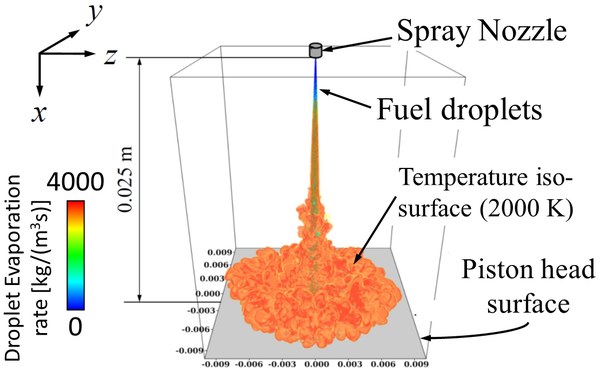
Figure 2: Instantaneous distribution of the iso-surface of gas-phase temperature at 2000 K, along with the dispersed-phase n-dodecane fuel droplets coloured by their respective evaporation rate. |
|
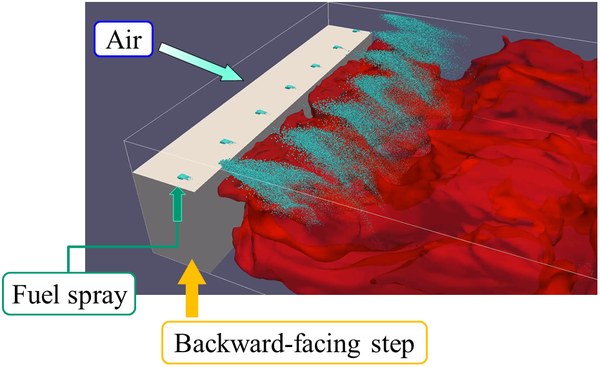
Figure 3: Spray combustion instability in a backward-facing step combustor. (Red iso-surface: Gas-phase temperature at 1500 K; Blue entities: Kerosene fuel droplets). |
Figure 4: Combustion noise generated by a turbulent Ethanol spray flame. Instantaneous fields of acoustic pressure perturbation p’ (gray scale), noise sources qe,rf (coloured contours), and Ethanol droplets (yellow entities). |

(機械理工学専攻)